What Will Not Obey
A Temple Lesson About the Shadow

Ninety-two days ago, I began writing a daily Substack post. After today, I’ll take a short break to devote time to editing my book. Before I go, I want to end with one last story that quietly shaped Right In Two.
Long before it was a temple, it was a kung fu school in a rough Boston neighborhood. That’s when he arrived. He was eighteen. Serious. Present. He came to commit himself to the work. Almost fifty years later, he’s still there. I call him the disciple.
I spent more time with him than with the master. Day after day, we worked together. Others had been there for decades before I arrived, accumulating knowledge, conditioning, and repetition that couldn’t be rushed. I stepped into the middle of that momentum.
Once, the master said to me, “You’re lucky. You’re stepping onto a train that’s already in motion. You’ll move faster than the others did.” That was true, but it carried pressure. I had to keep up. When the disciple saw me struggle, he would quietly pull me aside and work with me until something shifted.
During one of those sessions, he chuckled. I looked at him, puzzled. He said he’d been thinking about a meditation from the early days.
He had been watching the frustration build as he taught me a strike. He explained it clearly. I understood it intellectually. I told my body what to do. And when I tried to do it, I missed the mark. Again and again. No matter how much effort I applied, it wouldn’t land.
That’s when he told me about the “little man” meditation.
The structure was familiar. You sat. You breathed. You fixed your attention on a candle. You performed the kinjas to open the chakras. You closed your eyes and carried the flame with you as a tether to reality.
Then you imagined a small figure emerging from your body, from the big toe.
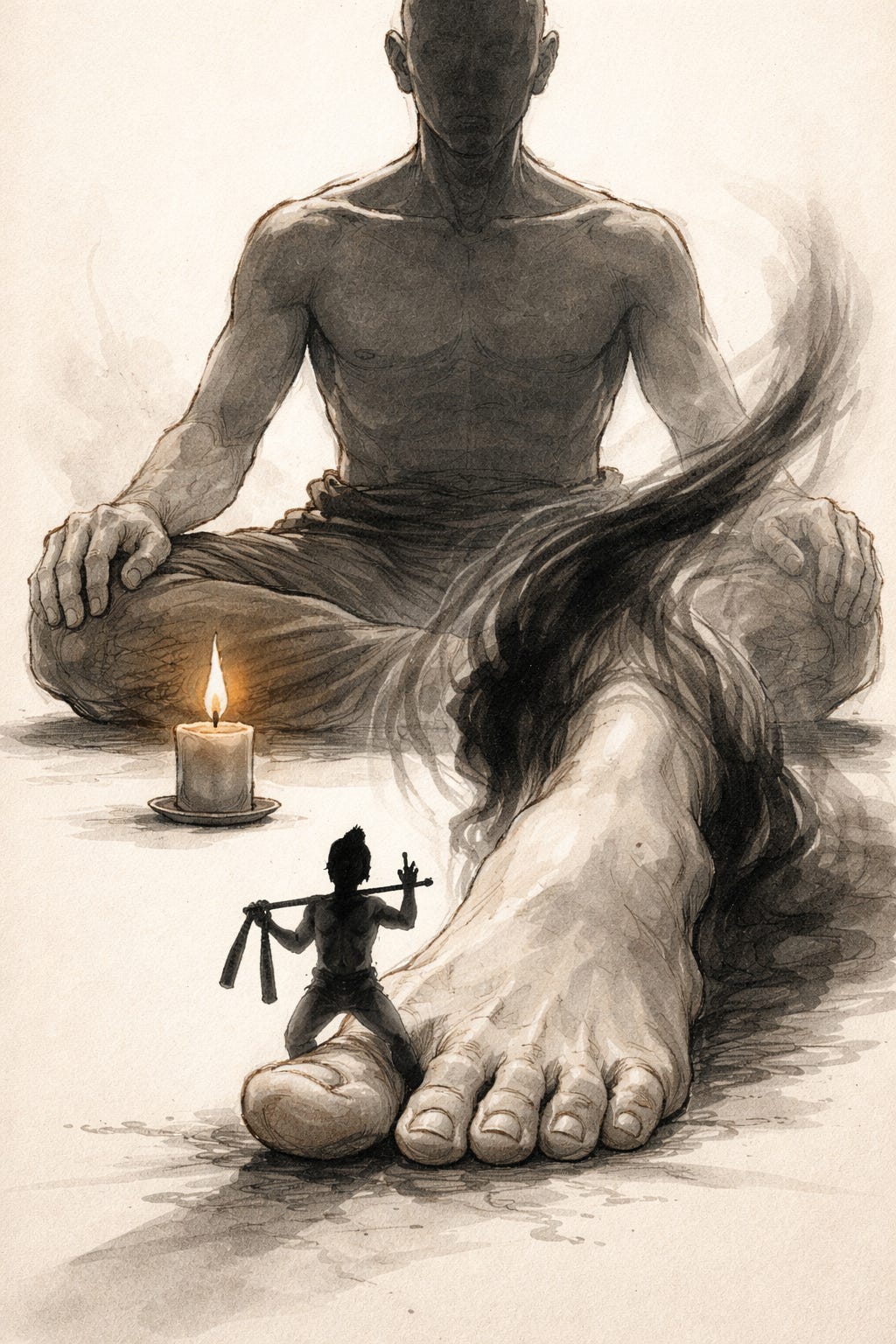
He paused there and laughed. The figure appeared exactly as described. But when it emerged, it surprised him. It was carrying nunchucks. It stepped free, turned back toward him, gave him the finger, mouthed “fuck you,” and hit him on the toe before running off.
He laughed harder then, and brought it back to me.
That meditation, and what I experienced not just in that class but many others with both him and the master, made something unmistakably clear. There is a part of us that does not respond to command, at least not at first. You don’t overpower it. You work with it. You negotiate. You make peace.
You’ve met that part too. You decide to eat clean, only to find yourself reaching for food you never planned to touch. You intend to get up and exercise, but remain on the couch. You check your phone again, even though you already know it won’t give you what you’re looking for. You push at the edge of your endurance, and a voice urges you to quit outright instead of easing back. You stay in a job long after it has drained your spirit. You know a relationship has ended, but you won’t walk away.
The meditation wasn’t about eliminating that part. It was about seeing it clearly. Once seen, it stops working against you from the background. You can begin to tell when it is leading you astray and when it is carrying information you’d been ignoring.
From that point forward, I stopped pretending that force doesn’t exist. I stopped trying to suppress it the way I’d been taught earlier in life. Carl Jung called it the Shadow. He understood why suppression fails. What we refuse to acknowledge doesn’t disappear. It waits. What we face honestly can be integrated. It becomes something we live with, rather than something that lives against us.
Right In Two is the story of how I came to make peace with that figure, and who I’ve continued to become since.
Before I step away, I want to say thank you.
To everyone who has read, shared, or quietly followed along, your presence mattered. Ganga Sharma, your encouragement arrived steadily and at the right moments.
Over the last ninety-two days, my wife, Amy, has sat at the opposite end of the couch each morning while I wrote. A small ritual formed. I finish the piece and hit send. A moment later, her phone chimes, marking the deadline I set for myself and the discipline of keeping it.
And Dave and Ann Fletcher. Ann was my commander when I served at NATO headquarters in Belgium more than thirty-five years ago. She and her husband stayed involved in my life long after their formal role had ended. They’ve known me across decades and across versions. Through these essays, they may now know me in a way that years of shared history never fully made possible.
I’ll be quiet for a bit. It’s time to finish the work.
Hello Dana, I am so moved by Your Warmth ☺️🧸💖. My Name is Ganga Sharma...Holy River...Love from India, Ganga 🪔