The Unfettered Mind
On mastery, trust, and the art of becoming the work

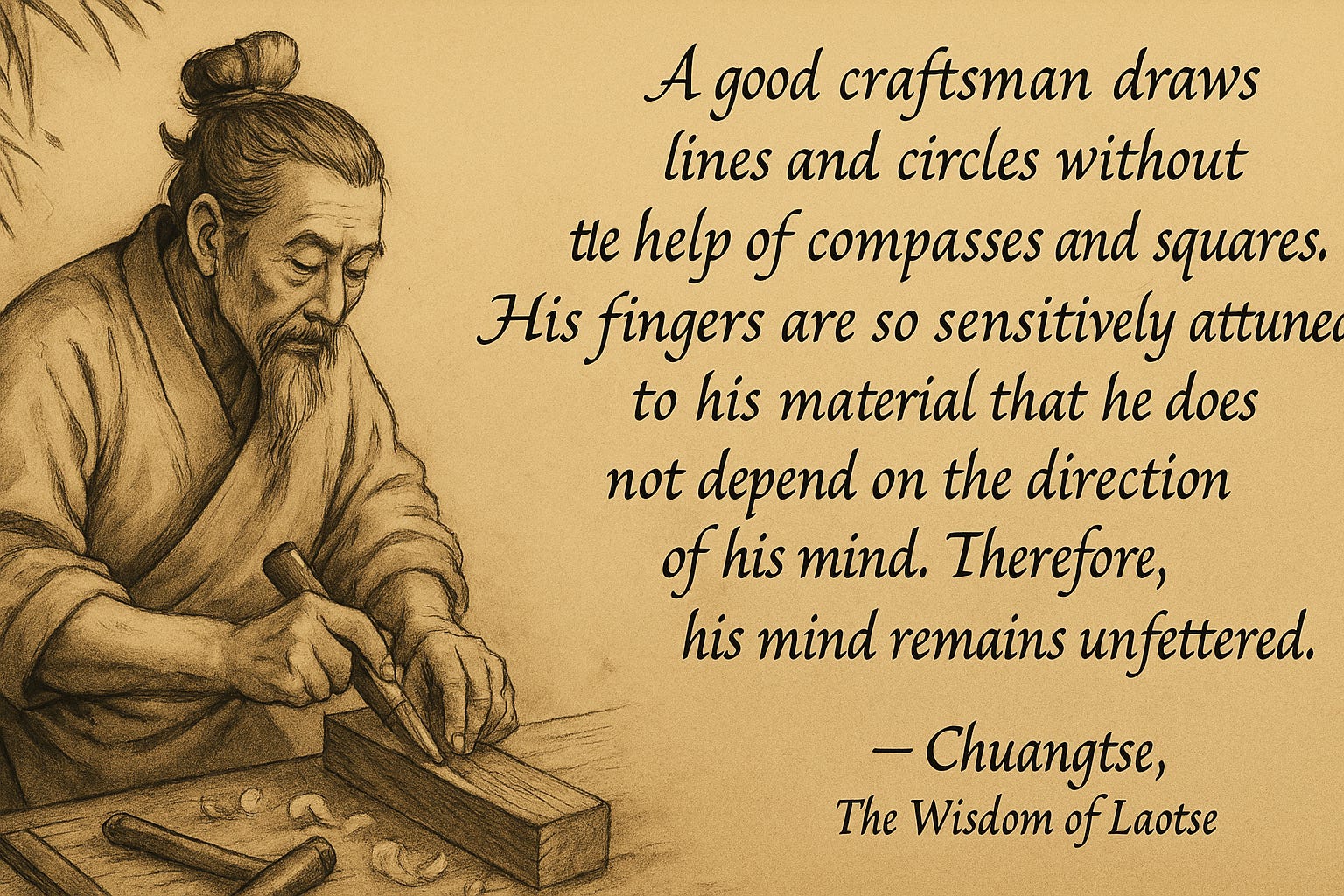
A good craftsman draws lines and circles without the help of compasses and squares.
His fingers are so sensitively attuned to his material that he does not depend on the direction of his mind.
Therefore, his mind remains unfettered.”— Chuangtse, The Wisdom of Laotse
There is a point in every art where control gives way to trust.
A painter’s hand finds its own rhythm. A potter’s wheel steadies itself. The musician stops counting the beats and starts breathing with them. The craftsman’s fingers know where to go before the mind has time to intervene.
We call this mastery, but it is really something quieter, the fading of division between doer and deed.
In the beginning, every act requires effort. The hand shakes, the mind corrects, the tool resists. We rely on rules, templates, and precision, our compasses and squares. These are necessary. Without form, there can be no freedom. But if we never release them, we become slaves to measurement. The mind becomes so busy directing the work that it forgets how to feel it.
Chuangtse’s craftsman has crossed that threshold. His fingers are sensitively attuned to his material. His body remembers what his mind cannot explain. He is no longer thinking about his craft. He is simply moving with it.
This is wu wei, effortless action. Not passivity, but the perfect balance between mastery and surrender.
It applies far beyond the workshop. A parent who stops trying to manage every outcome and starts responding to the child before them. A leader who stops performing competence and begins listening. A runner whose stride becomes breath. A driver who merges onto the highway, loses self-consciousness, and becomes completely absorbed in the motion. The car moves, the hands respond, and thought falls away.
The Taoists called this state Chang, the moment when awareness and action merge and doing arises from being. The Japanese tradition of Zen speaks of the same stillness. It cannot be rushed or purchased. It emerges only through presence, humility, and time.
To reach that stage requires thousands of hours of honest practice. Not mindless repetition, but failing, refining, and returning, again and again until the struggle dissolves into stillness. This is the privilege of the pursuit of excellence: to stay with something long enough that effort transforms into grace.
The goal is not to eliminate discipline or abandon skill. It is to let both ripen until they no longer require attention. Then the compass can rest, and the line will still be true.
The good craftsman does not draw circles to impress anyone with their symmetry. He draws them because that is where the hand leads when the mind is free.
The result is not perfection, but harmony between thought and action, self and world.
Maybe the point is not to become skillful, but to become so present that the skill disappears.