The Comtoise
A moment in the making of Right in Two

A brief update before the excerpt.
This weekend, I’ll finish my part of the structural edits on Right in Two: A Journey Through Division, Discipline and the Way of Tao and place the manuscript back in Jeannette de Beauvoir’s hands so she can do what only distance and craft allow.
Working this closely with the book has made something clear. Some stories ask to be witnessed, not tucked away. This one needs an agent. It needs a publisher. That work comes next.
For now, I want to share an excerpt. Not because it explains anything, but because it reminds me how lessons arrive. Often before we have language for them. Often carried by people who never knew they were teaching.
This is for Ann.
For David.
For Jan and Mireille.
Thank you for your kindness.
Thank you for the lesson.
I love you.
The Comtoise
I could feel the shift happening. In more ways than one. Years earlier, before the temple, before the master, before any of this, I’d met another man, a Dutch Air Force Colonel named Jan. One evening he told me something that’s stayed with me since.
My commanding officer Ann—the same Ann who would later pin captain’s bars on my uniform while my mother watched—and her husband David invited me to dinner at Jan’s and Mireille’s home. Six years earlier I’d been riding around in a beat-up Camaro on a desolate Maine road, wondering if I’d ever get out of that town. Now I was following them through the gates of a château estate, wearing a sport coat I’d just bought at the PX, reminding myself: start with the outside utensils and work your way toward the plate.
The pendulum had swung. I just didn’t have words for it yet.
Mireille was Parisian. She worked for me at the NATO finance office—an arrangement that still felt absurd. A kid from mill-town Maine supervising a woman who’d lived through more history than I’d ever read. Her accent was so thick it took me a moment to catch up to her sentences. When de Gaulle kicked NATO out of Paris, she’d followed her job to Belgium. That’s the kind of person she was. The work mattered more than the city.
One afternoon at the office, in passing conversation, she mentioned that her parents were Jewish.
“Oh, I didn’t know you were Jewish,” I said.
Panic struck her face. “Oh my. I hope that’s not a problem for you.”
I was shocked by her reaction. I thought I was making polite conversation. But the war had never ended for her. Almost half a century had passed, but it still lived in her body. She was just a child when it happened.
And she was still scared.
The pendulum swings. But some people never stop bracing for its return.
The table that night was set with linens that had survived the occupation. Crystal that had seen soldiers. I kept my hands in my lap, afraid to touch anything.
I couldn’t stop looking at the clock.
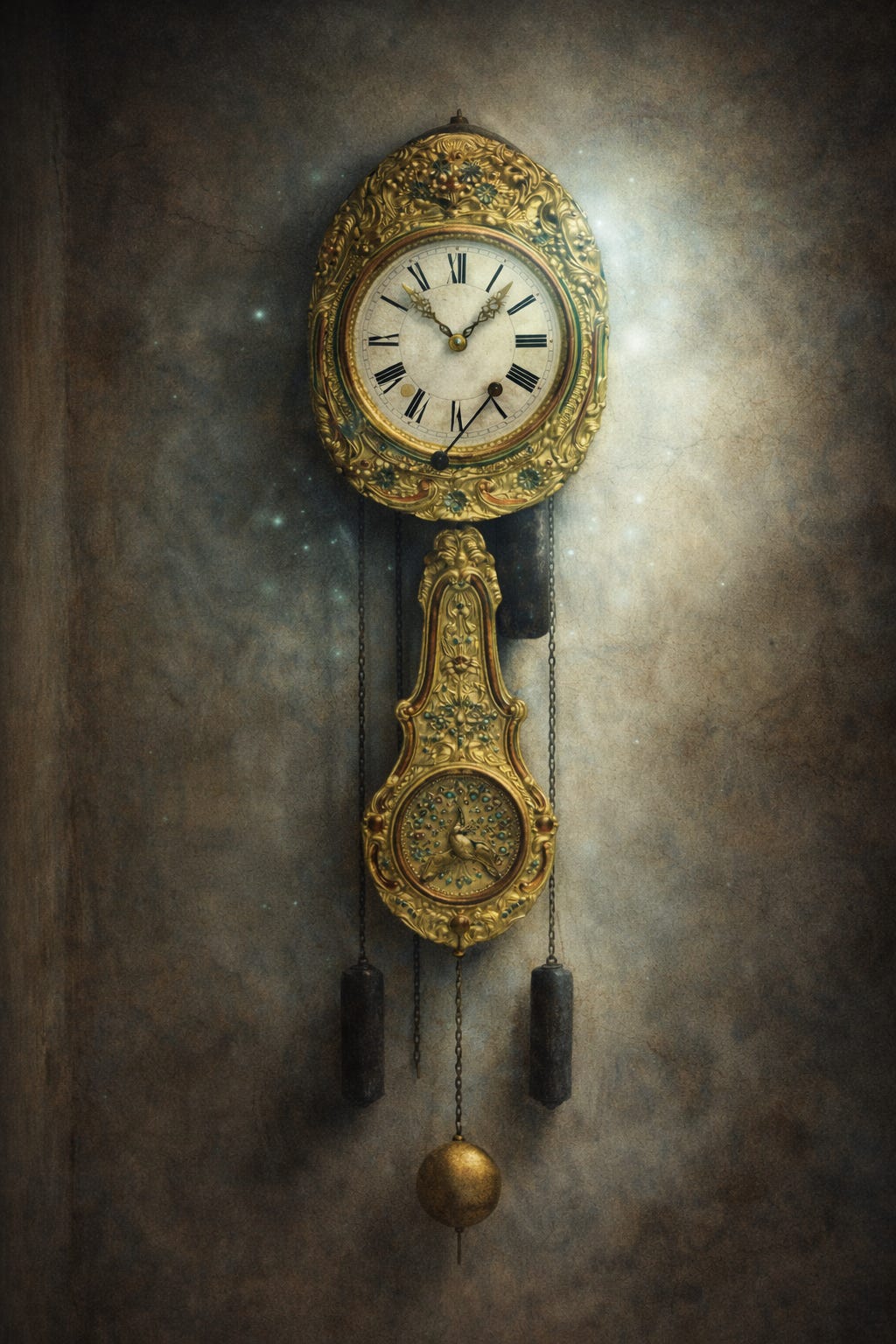
It hung on the wall opposite me. Tall. Mounted on dark wood. To me it looked like a grandfather clock that had lost its case—the pendulum fully exposed, swinging in slow, hypnotic arcs. Its face was framed by ornate golden brass pressed into shapes I couldn’t quite make out—flowers, scrollwork, figures emerging from the metal. The pendulum itself was massive, decorated with the same elaborate work.
Mireille noticed.
“You like the clock?”
“I can’t stop looking at it.”
She smiled. “It’s a Comtoise. From the Jura mountains. Very old. My grandmother had one just like this.” She touched the brass frame. “This work here, we call it repoussé. Pushed from behind. The craftsman shapes it by pressing from the back, so the pattern rises toward you.”
I nodded like I understood. I didn’t. But I understood that I was sitting in a room with objects that had stories longer than my entire family’s time in America.
Over dinner, Mireille told us about the officers’ club in Paris after the war. NATO was still taking shape. The men who gathered there had been enemies just a few years before. Germans sitting across from the Dutch, the French, the British, the Americans. During the work week, everything was professional. Polite. Controlled.
“But Friday nights, once the drinking started—” She made a gesture with her hands. An explosion. “Fights. Chairs thrown. Noses broken. Old scores settled with fists.”
She laughed. But it wasn’t funny.
“And Monday?”
“Monday, back to work. Like nothing happened.”
I thought about that. Men who had watched their countries burn, now sharing conference tables. The war had ended. The rage hadn’t. It just waited for Friday. Then swung back to Monday. Back and forth. Week after week.
After dinner the others drifted away. Jan and I sat alone. The room grew quiet except for the clock’s steady tick.
Jan was a careful man. Precise in his movements. Deliberate in his words. He’d been a boy during the Nazi occupation. Six years old when German soldiers took over his street, his house. He’d watched war unfold from his front window. Bodies in the street. Neighbors disappearing. The slow starvation. Then liberation. Then the long rebuild.
“As long as there’s a Dutchman alive who remembers the war,” he said, “the Dutch will never forgive the Germans.”
He let that settle.
Then he pointed to the Comtoise.
“You’ve been watching it all night.”
“I know. I don’t know why.”
“I do.” He leaned back. His eyes on the pendulum. “Life is like that clock. It swings back and forth. Sometimes with violence. Sometimes so gently you barely notice. People panic when it swings. They chase it to one side, then scramble back when it moves the other way. They exhaust themselves reacting.”
He watched the brass weight arc through its path.
“But you don’t have to swing with it.”
He looked at me then. And I had the strange sensation that he was speaking to someone I hadn’t become yet.
“Let the world careen. Hold your center.”
That night I was twenty-three years old. Firelight playing across brass shaped by hands dead for centuries. I didn’t understand any of it.
But it felt like every moment leading up to this one had been pointing here. Every nudge. Every turn. Every unlikely door. To those people. That night. That clock.
So Jan could give me that lesson.
I carried those words for decades. Through the Army. Through corporate America. Through the temple. Years later, when the master spoke of Taoist stillness, of clarity before action, I realized they’d been saying the same thing all along.
But everywhere else in my life, I had swung hard.