The Apprentice
Wrapped Around Your Finger

There is a transaction as old as knowledge itself.
One man holds something another man needs. Not money, not status. Something closer to the bone than that. A way of moving through the world. A stillness the second man can see but cannot yet access. He crosses whatever distance he has to cross and he presents himself and he says, in whatever words his tradition uses: teach me.
The teacher looks him over. Decides. Names his terms.
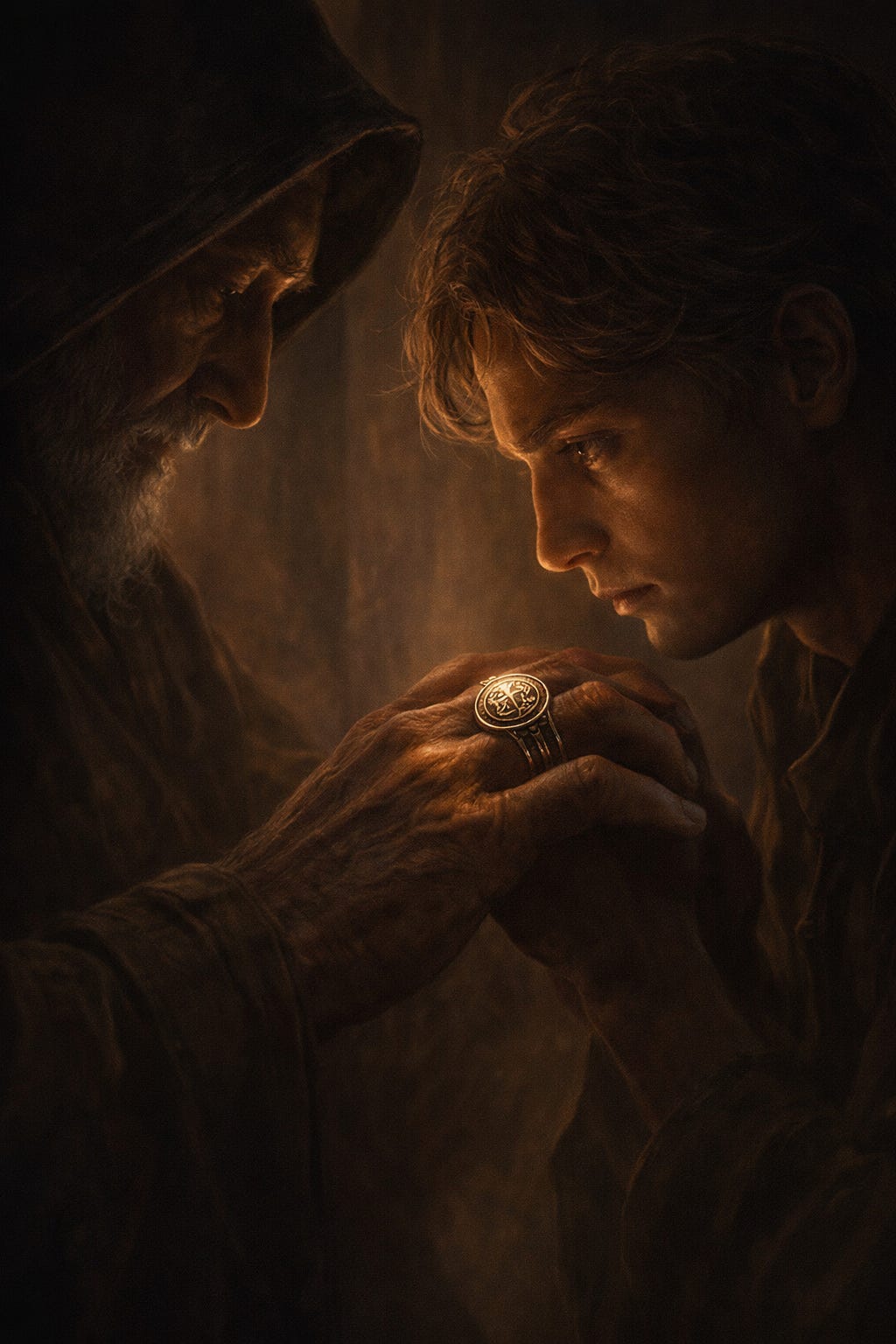
The apprentice agrees, sometimes before he fully understands what he’s agreeing to. That’s part of the arrangement. You can’t fully understand the cost of something until you’re already inside it, and by then the only direction is through.
This transaction has repeated itself across every culture, every century, every discipline that requires more than a textbook to transmit. Socrates and his students. The samurai and his master. The monk who walks into the monastery and doesn’t walk out the same man. The physicist who spends a decade in a great mind’s orbit and comes out carrying something that can’t be taught in a lecture hall.
The knowledge is real. That’s what makes the transaction work. Both sides believe they’re getting the better end of it, and in a way, both are right.
In 1983, Sting wrote the whole thing down.
“You consider me the young apprentice / Caught between the Scylla and Charybdis / Hypnotized by you if I should linger / Staring at the ring around your finger.”
Homer’s trap: two monsters on opposite shores, survival requiring you to decide which kind of destruction you can live with. The apprentice in the song is not naive. He sees the dynamic clearly. He knows the hypnosis is operating. He stays anyway, because the alternative is turning back, and turning back means returning to the person he was before he knew the knowledge existed.
“I have only come here seeking knowledge / Things they would not teach me of in college.”
That line is the oldest line in the world. It’s every man who ever understood that what he needed couldn’t be certified or credentialed or handed to him by an institution. It has to be transmitted. Person to person, presence to presence, over years that change the shape of what you are.
The hypnosis is not weakness. You don’t stare at the ring because you’re blind. You stare at it because the ring is real. The power it represents is real. You have correctly identified that proximity to that power is the only way to acquire what you came for.
The cost is that you see certain things later than you should.
The transaction always has two sides.
On the apprentice’s side: hunger. The willingness to subordinate, to receive, to stay in the strait past the point of comfort because the knowledge is worth the monsters. This is not a small thing. Most men can’t do it. The ego resists. The need to already-know, to already-be-sufficient, to not stand in front of another man as a student. That resistance kills more potential than any lack of talent ever has.
On the master’s side: something the song understands but doesn’t editorialize about. He needs the apprentice too. Not in the same way, not with the same hunger. But the master without a student is a library no one enters. The transmission requires a receiver. The lineage dies without someone willing to carry it forward. The apprentice thinks he is the supplicant. He doesn’t yet see that the architecture requires him.
“When you find your servant is your master.”
The reversal isn’t conquest. That’s what youth gets wrong about that line. It isn’t standing over something, winning something. It’s quieter than that and stranger. It’s the moment you realize the knowledge has moved, that it lives in you now and not only in the temple, that you have become the thing you came seeking, and the relationship that produced you is now a different kind of relationship, whether either party is ready for that or not.
Every apprentice reaches this moment eventually. If the teaching was real, it is inevitable.
What the song doesn’t tell you, what no song can tell you because you have to live it to believe it, is that the archetypal pattern doesn’t stay archetypal. It finds specific men in specific places and it runs through them like current through wire.
I was fifteen years old in 1983 when I first heard it.
I had no idea it could actually come true.
But it did.