On Lizzy Falcon
The Artist Who Gave Shape to the Things I Had Only Felt

I discovered Lizzy Falcon more than a decade ago. One image found me, then another, and before long her work hung throughout my house, each piece carrying a quiet voltage I never had to explain. The figures she creates, especially the wide, searching eyes she is known for, seem to hold beauty and ache in the same breath. They do not look at you so much as through you, as if they recognize something you have spent years trying to name. Her work does not imitate duality. It understands it.
Long before Lizzy’s art entered my life, I had been circling the same tension in my training. Before those years, duality felt like something occasional, a passing contrast that appeared and disappeared without demanding much attention. A shadow beside a light. A softness beside a hardness. One of those features of life that you notice in a moment but forget just as quickly.
Those years overturned that idea completely. I learned that duality is not an occasional visitor but the underlying structure of things, the quiet current beneath every surface. And once you sense that current, you stop treating opposites as disruptions. You begin to understand how they belong together, how each one leans into the other, how nothing stands alone for very long.
What surprised me when I first encountered Lizzy’s work was how clearly she seemed to paint from that same current, as if she had spent her entire life studying the same divide I had been taught to sense. Not through parallel training, but through that deeper alignment of instinct, the kind that needs no shared vocabulary. Her art felt like recognition. It met me at the place where opposites press against each other, where innocence and awareness, beauty and sorrow, waking and sleeping hold each other in balance.
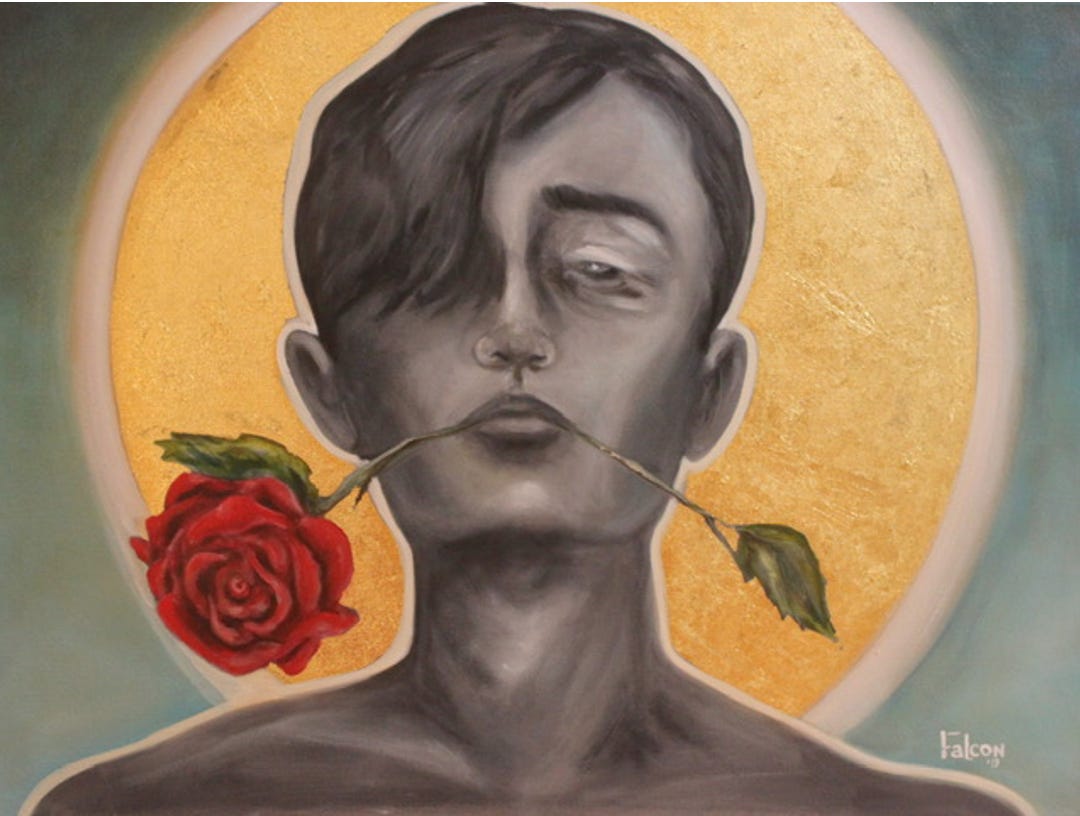
Every so often, before a major show, she would send me an image. My reactions always came instantly. Sometimes it was a brief comment. Other times, like the day she sent the piece that inspired the poem below, the response rose up in a single wave. I did not think about what I was writing. Her art struck something that had already been formed in me, and the words simply followed. It felt as if she had reached into the same well that shaped my years at the temple, giving the tension its form on canvas while I gave it language.
It became this:
Let Me Sleep
Keep our sleep Prince Gabriele
and leave us rest in slumber
Lay us down on righteous clouds
and cast our dreams asunderIf by chance we do sleepwalk
and begin to go astray
Guide our steps from left to right
and return us to the wayWake us not great Morning Star
please commit us in these throws
Spare awareness of the pain
of thorns beneath the rosePrey on those who seek to know
but please leave us to be free
From golden haloed light of knowing
that makes the blind to seeBeing halved in earthly life
is to hope to be made whole
And living life so unaware
is respite for the soulStill some will stroll outside the norms
and find wisdom in your prose
Eagerly accepting of both the pain
and beauty of the rose
The poem came from a question the Master and I used to circle often: is it better to wake or to remain in the dark. We were never debating enlightenment. We were trying to understand the cost of awareness, the way clarity brings its own kind of ache, and how some people carry that responsibility easily while others find more rest in not knowing. Both choices made sense to us. Both held truth. Both demanded respect.
Lizzy’s work lived inside that paradox. The big, haunting eyes in her figures seemed to know both sides at once, the tenderness of innocence and the quiet grief of seeing too much. They held the longing to stay untouched and the inevitability of awakening in the same expression. Her art gave shape to the very tension I had been trained to feel, the place where comfort and consciousness meet without fully merging.
Looking back, I see that her work did not transform me. It recognized me. It reflected back the same principles I had been formed by in the temple, the same devotion to opposites, the same willingness to sit inside the tension rather than resolve it. Her art lifted the mirror I had never been able to find on my own, and for the first time, I could see myself clearly in it.
And the truth is simple.
Sometimes art meets you long before you are ready to understand why.
Sometimes it waits until you finally do.