Moon
Learning the Tao from a man who never read it.

On the wall of our family camp on a small pond in Maine hung my father’s collection of what he called his Indian pictures. He never explained why they mattered to him. He simply lived with them, the way some people drift into harmony with their surroundings without ever naming the feeling.
The End of the Trail came from a yard sale one summer. A rider at dusk, body lowered, spear pointing toward the earth, his horse carrying him the last stretch of the path. My father never saw defeat in that image. He saw truth. A man who had reached the end of his road and no longer needed to push.
The Native woman in her canoe came from my mother’s father. It had hung in my grandfather’s camp before it found a home in ours. Water still as glass. Moonlight behind her. A scene without urgency. A kind of stillness that feels like a prayer.
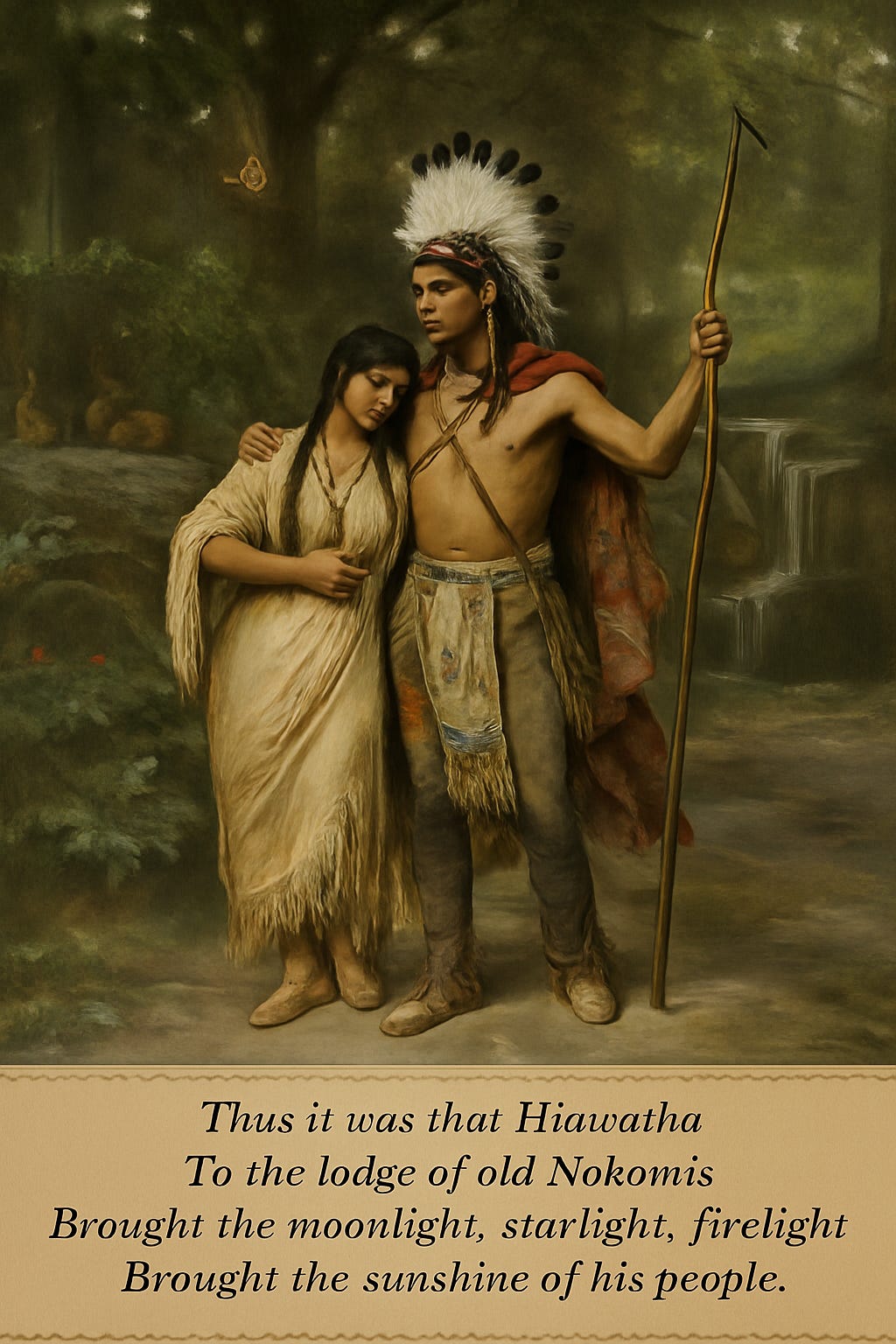
And Hiawatha’s Wedding Journey came from my father’s older brother, the one among ten siblings who called simply to talk. He knew Moon loved the print, so he gave it to him while he was still alive. It was a quiet act of recognition between two men who understood each other more than they ever said aloud.
In that picture, Hiawatha walks through the forest with his wife beside him, her head resting softly against him. A portrait of balance and companionship. A life that moves side by side rather than ahead or behind.
These images shaped the atmosphere of our summers. The quiet pond. The smell of pine. Light settling across the water at the end of the day. Everything calm. Nothing forced.
My father’s real name was Norman, but no one called him that. Everyone called him Moon. There were theories about the nickname. One story said that when he was young he mispronounced a word and it came out as lune, the French word for moon. In that part of Maine, everyone slipped between French and English without thinking about it. The name stayed. It suited him.
He went to church because that is what people did, but his real understanding of the world came from something quieter and older. He lived with an instinctive sense of alignment. He did not try to bend life into shape. He accepted what arrived and let go of what passed.
It took me years to recognize that.
I had to go out into the world. I had to push and strive. I had to try to carve the world into whatever I thought it should be. Only later did I find a teacher, learn a different rhythm, and discover the Tao. Only then did I see that my father had lived in harmony long before I had the words.
During one meditation session my teacher recited a passage from the Tao Te Ching. Not as a formal quote. Not as instruction. He spoke it like something familiar, a truth one returns to rather than strives for.
There are those who try to conquer the world
and shape it as they wish.
It never works.
The world is a vessel not meant to be gripped.
Force breaks it.
Control loses it.
Some things advance.
Some fall back.
Some burn hot.
Some move cold.
Some rise strong.
Some arrive fragile.
Some endure.
Some fall away.
The Sage avoids excess.
He avoids extravagance.
He avoids pride.
As I listened, I thought of Moon. A man who never forced anything. A man who moved with life rather than against it. A man whose quiet pictures were teachings I was too young to read.
Today the Hiawatha print hangs on a wall in the Maine lakefront camp my wife and I restored in his honor. We call it MoonBud. Bud was her grandfather, a man who built their family camp on the side of a mountain in Eustis near Flagstaff Lake. Two Maine men who never met, linked now in a place meant for calm, reflection, and the simple truth of being where you are.
I had to go out into the world to find the words so I could understand what my father already knew.
Moon never studied the Tao. He felt it.
And each summer evening, when the light settles on the lake and the loons begin to call, I feel closer to him than ever before.
If One Can Connect with Family...........Love, Ganga 🪔🕊️🕯️