Killing Time
The Days We Give Away

The third eye is often buried under mysticism. Symbols, colors, rituals. As if it belongs only to monks or visionaries or people who have stepped outside ordinary life. That was never how it was described to me.
The master spoke of it in practical terms. The third eye was what happens when attention stops scattering. When sight, sound, sensation, and intuition gather into a single field. Nothing heightened. Nothing imagined. Just presence without fragmentation.
You aren’t watching your life from a distance.
You are inside it.
The present moment.
When that happens, time feels intact. Not faster or slower, but whole. Nothing pulls backward into memory. Nothing reaches forward into anticipation. Experience moves cleanly, without lag or echo. Life meets you exactly where you are.
Most people only touch this state by accident. In moments of danger. In deep concentration. In love. And then it slips away again without explanation. Attention fractures. The familiar drift returns. Time thins.
What most people never realize is how often this separation is encouraged.
I watch younger people listen to Pink Floyd’s Time for the first time on YouTube. Many of them have never known FM radio. They expect something old. Historical. A classic they’re supposed to respect.
What happens instead looks like discovery.
Someone once commented that watching a person hear Pink Floyd for the first time is like watching them enter a new realm of consciousness. It sounds dramatic until you see it. The moment when posture changes. When evaluation drops away. When something quiet opens behind the eyes.
The song eases in slowly, almost deceptively. A steady, clock-like rhythm settles the body. Breathing syncs. Muscles loosen. Then, without warning, the eruption of alarms breaks the surface. Abrupt. Jarring. A thousand clocks going off at once.
You wake up.
The rhythm returns and carries you again. And then the words arrive.
Ticking away the moments that make up a dull day.
You fritter and waste the hours in an off-hand way
I’ve seen this moment too many times to miss it. The lyrics don’t land intellectually. They land viscerally. You can see the instant recognition sets in. Not nostalgia. Not sadness yet. Recognition.
You fritter and waste the hours in an off-hand way
Kicking around on a piece of ground in your home town
Waiting for someone or something to show you the way
Tired of lying in the sunshine staying home to watch the rain
Faces go still. Eyes soften. The defenses people didn’t know they were holding begin to loosen. Something unravels quietly.
You are young and life is long and there is time to kill today
And then the one day you find ten years have got behind you
No one told you when to run, you missed the starting gun
That’s when the tears start to come.
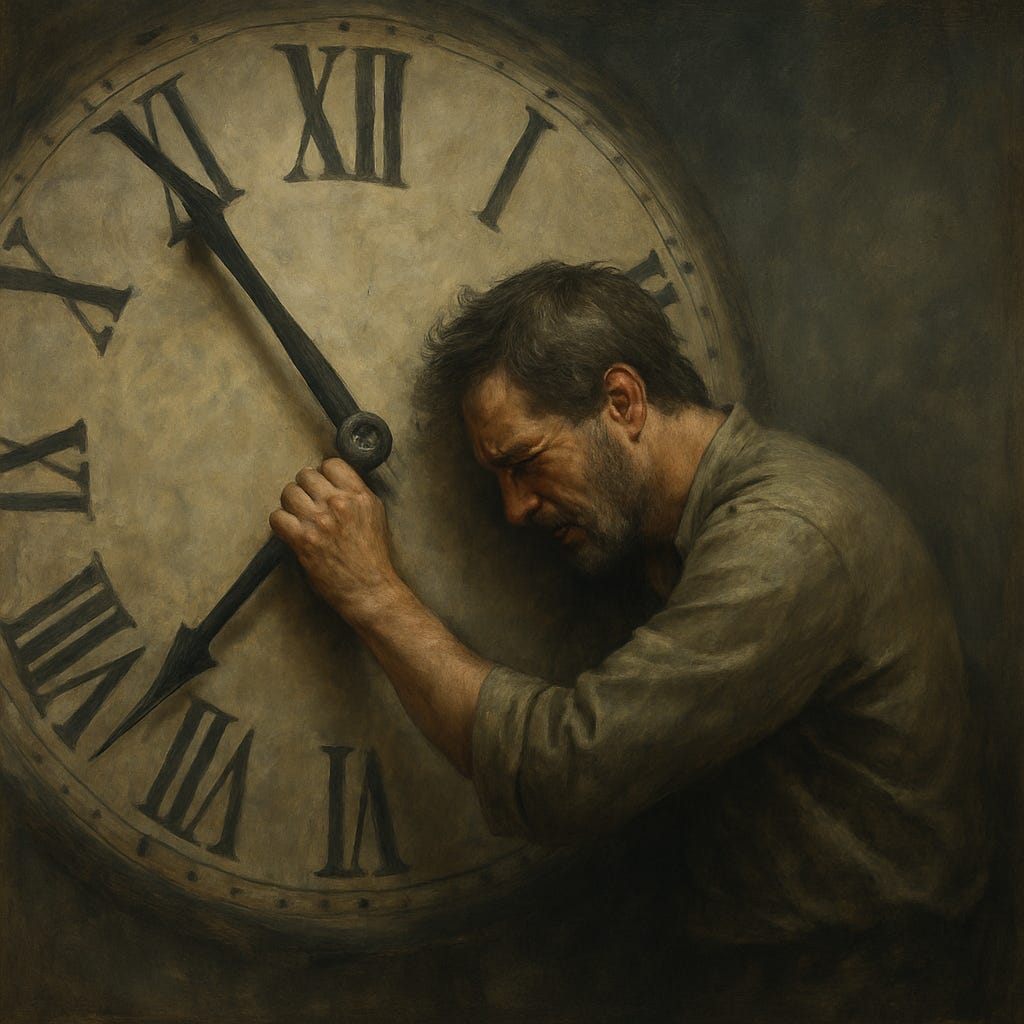
They are not grieving youth. They are not mourning innocence. What they’re feeling is sharper than that. They are realizing how many days they didn’t lose, but gave away. Not to catastrophe or crisis, but to waiting. To distraction. To living just slightly outside the moment they were in.
By the time those lines arrive, the recognition has already taken hold. The song doesn’t accuse. It doesn’t explain. It simply describes. And that’s what makes it unbearable.
Then David Gilmour’s guitar enters, like a funeral procession. What’s being mourned is not time itself, but the death of days that cannot be undone.
It doesn’t rush. It doesn’t resolve anything. It rises slowly, almost reluctantly, like smoke. Less a solo than a vigil. The words have already done their work by then. The accounting has begun.
What the guitar gives voice to is what language can no longer carry.
And you run and you run to catch up with the sun, but it’s sinking
And racing around to come up behind you again
The sun is the same in a relative way, but you’re older,
Shorter of breath and one day closer to death
It sounds like mourning. Not for time itself, but for versions of themselves they didn’t know were quietly slipping away. The lives they assumed they would return to later. The attention they didn’t realize was the only thing that was ever required.
Long before I had language for this, the master named it simply.
People think time is something that happens to them, he said.
They don’t realize it’s something they leave.
He explained that what older traditions called the third eye had nothing to do with visions or mysticism. It was attention gathered into one place. When awareness stayed whole, you weren’t ahead of your life or behind it.
You were present for it.
Most suffering, he said, begins when we abandon that place. When attention is pulled backward into what cannot be changed, or forward into what has not yet arrived. Regret and promise. Memory and anticipation. Two poles that stretch awareness thin and allow life to slip quietly through the middle.
Life does not pause when attention leaves.
It keeps going.
The antidote he offered wasn’t urgency or discipline. It was noticing. Returning. Again and again. Letting all of yourself arrive where you already are.
Watching those videos now, seeing people encounter this truth through a song written decades ago, I’m reminded how patiently it waits. How gently it repeats itself. How it doesn’t need explanation to be understood.
The clock keep ticking either way.
The difference is whether you are awake to hear it.