Chemin de Désir
The Desire Path

I was out for a run last week and came across something I’d seen a hundred times but never really pondered: a paved sidewalk curving to the right, and right next to it, a beaten dirt trail cutting straight across the grass, connecting the shortest distance between two points.
I stopped running. I stood there staring at it. And I thought about Dave.
Dave started a landscaping company in the 1970s with a shovel and a beat-up pickup truck. He and his wife turned it into a multimillion-dollar local empire. He’s retired now but he still helps me out. I’ll call him and the next morning skid steers and backhoes are digging up my lawn before I’m even out of bed. I still drive around town with him sometimes. He has a story for every house we pass. He taught me more about design than any business book I’ve ever read, and one thing he said has stayed with me for years:
“Nature doesn’t move in straight lines. Everything has to flow. Plant things to guide people down the path you know they’d naturally walk.”
Standing over that dirt trail, I understood what he meant in a way I hadn’t before. It turns out urban planners have a name for what I was looking at. They call it a chemin de désir, a desire path. An architect designs the walkways they think people should use. Then people wear their own routes based on where they actually need to go. Over time the dirt path becomes more worn than the paved one. Some planners fight it. Signs. Fences. Hedges. More rules. They treat the desire path as a failure of compliance. Others, the ones who’ve learned something, watch where the paths form and pave those instead. Some university campuses are famous for this. They’ll lay sod, wait a semester, observe where students actually walk, and then pour the sidewalks along those worn trails.
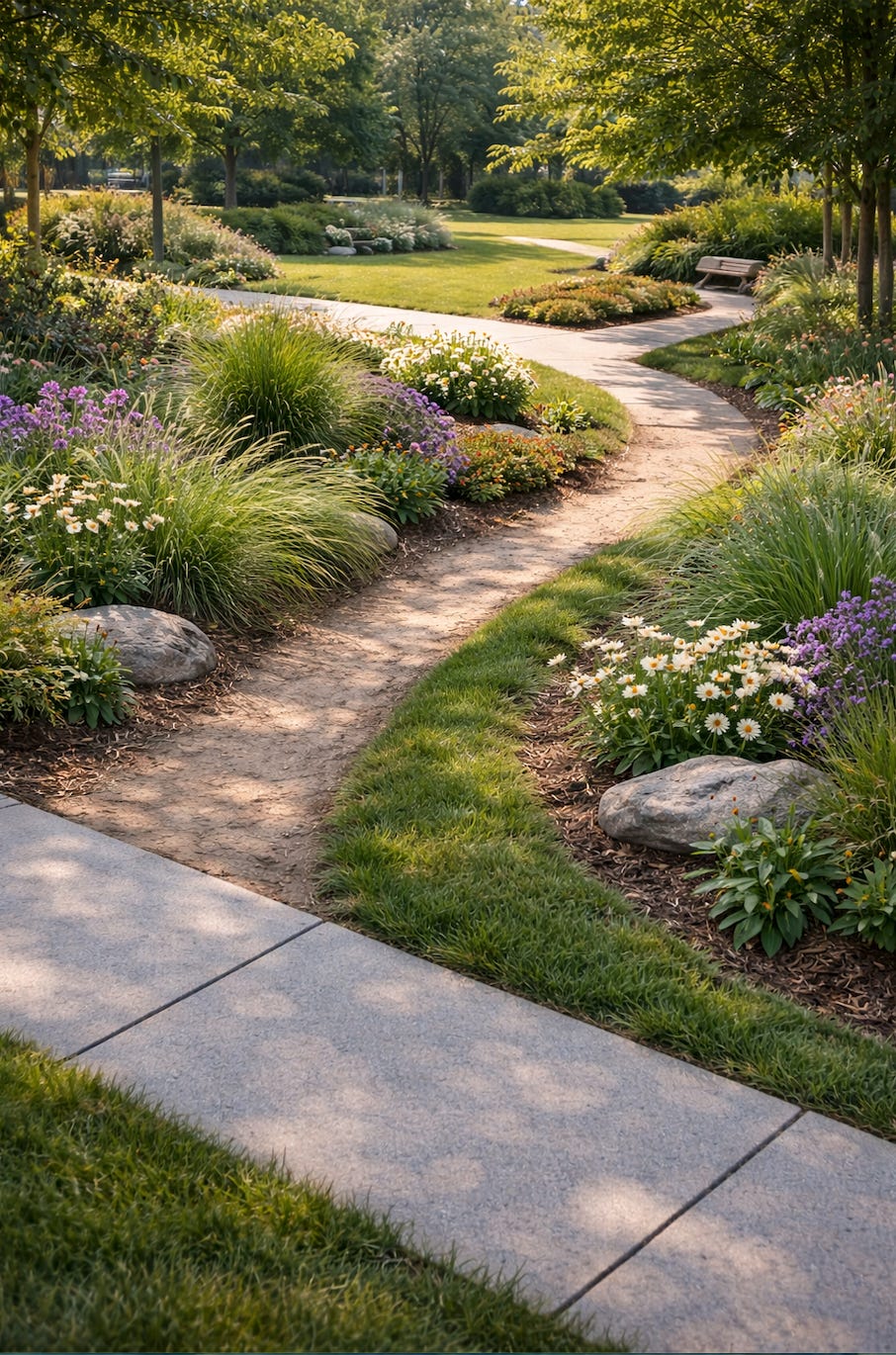
Dave would pave the desire path and border it with plantings so natural they’d look like the path was built between them.
Dave has never read the Tao Te Ching. He wouldn’t know wu wei from a wheelbarrow. But he practices it every day. He doesn’t force landscapes into rigid geometry. He watches how people move, how water flows, how light falls, and then he designs around those natural patterns. The result feels inevitable, like the path was always meant to be there. Twenty-five hundred years ago, Laotse described the same principle:
“The best of men is like water; water benefits all things and does not compete with them. It dwells in the lowly places that all disdain, wherein it comes near to the Tao.”
Water doesn’t fight the terrain. It finds the natural path. And in finding it, it shapes the landscape more powerfully than any force applied against it.
Dave never starts a project by drawing lines on paper. He walks the property. He watches the light. He studies where people naturally enter and exit, where they pause, where they hurry. Then he designs a landscape that honors those patterns while guiding them toward something more beautiful than they would have found on their own. The highest form of his craft is invisible. You walk the path. You enjoy the garden. You never think about the designer. That’s the point. Laotse understood this too. He wrote that of the best rulers, the people only know that they exist, and when their work is done, the people all remark:
“We have done it ourselves.”