Broadcasting and The Human Operating System
Clarity, confusion, and modern influence

Ask ten people what the word spirituality means and you will get ten different answers. For some it sounds like church, prayer, or belief. For others it is softer and more abstract. Being one with God. Connecting to a higher being. Feeling aligned with the universe. The answers tend to circle rather than land. They gesture toward something without naming it.
The master was clear with me from the first day I met him. “Spirituality,” he said, “is seeing reality clearly.” That was it. No mysticism. No hierarchy. No promise of transcendence. Just clarity.
He often spoke in images. Most of us, he said, are moving through life with our windshields coated in mud and debris, reacting to shapes and shadows we can barely make out. His role was not to give us better maps or new destinations. It was to help us clear the glass so we could see what was already there. Confusion, he warned, was the greatest impediment to clarity.
That stayed with me because it was practical. It implied responsibility. And over time, it quietly unsettled the way I thought about myself. I began to notice the rules and rhythms that governed how I thought, responded, acted, and interacted. Not my beliefs exactly, but the current running underneath them.
I started thinking of it as a kind of human operating system.
Once I saw it that way, certain characteristics became impossible to miss. The system is open by design. Suggestible. Pattern-hungry. Socially writable. That is how we learn language, absorb culture, fall in love, and survive. It is also how confusion takes hold.
Ideas behave like code. So do emotions. So do the stories we repeat long enough to mistake for ourselves. Fear installs fast. Anger bypasses safeguards. Moral certainty disables reflection. Much of this runs below awareness, which is what makes it dangerous.
I had already seen this long before I had language for it. The Army made it unmistakable. I was trained to respond without hesitation, to subordinate instinct to command, to do what I was told, no questions. Over time, that responsiveness stopped feeling imposed and began to feel normal. That is how writable the system really is.
Before the Army, the church had done it to me.
Driving through Germany as a young officer made something else impossible to ignore. The country was mythically beautiful. The landscape. The mountains. The forests. Ancient architecture that had survived. Towns that felt like living storybooks, places closer to fairy tales than to history. It was difficult to reconcile what I was seeing with what I knew had happened there.
The question stayed with me. How could entire populations change direction so quickly. How could so many people come to see the world differently, almost all at once, with so little hesitation.
I understand it differently now. You do not need monstrous people. You need enough distortion. Enough fear. Enough infused emotion to cloud perception. Throw enough dirt on the windshield and eventually people stop seeing clearly. At scale, the result is not confusion alone. It is collision.
If the system was that writable, then I wanted to understand how it happened. Not morally. Mechanically.
That is when I found myself fixating on a word I had never really questioned before.
Broadcast.
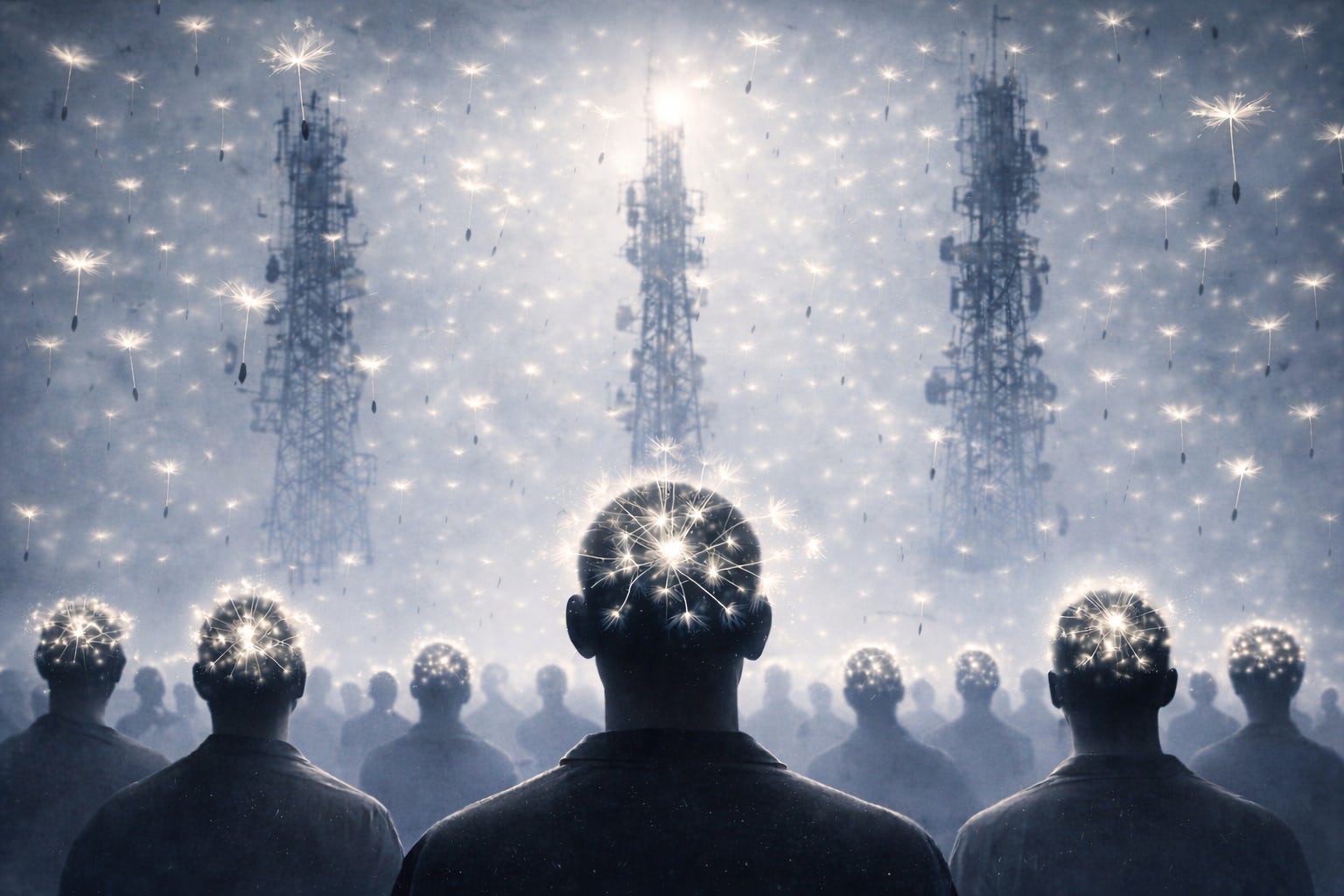
What did that word have to do with television or radio, other than the fact that it was the word we had always used. Broadcast felt like airwaves, not soil. Signal, not seed.
So I dug into it.
I learned that broadcast is a farming term. To broadcast meant to scatter seeds widely, casting them across a field rather than placing them carefully, one by one. Over time, the seeds changed. What was once grain became ideas.
As technology accelerated, distance collapsed. Voices traveled without bodies. Images arrived already charged with emotion. Repetition shortened reflection. Fear could be infused at scale.
The impulse remained. The delivery did not.
Ideas were no longer scattered and left to weather. They were repeated. Reinforced. Saturated. Emotion arrived before context. Meaning hardened before it could be examined.
And then it shifted.
We kept thinking of it as airwaves. Broadcast. Signals moving outward, thinning as they traveled. But we no longer had language for what it had become.
The signal stopped being blunt. It became precise. Continuous. Bidirectional. Responsive. It no longer waited to be received. It followed. It learned. It adapted. The field disappeared. There was no season. No distance. No edge.
Lacking a better word, we called it social media.
Our human operating system was never built for any of this.
Which brings me back to the master, and to prayer.
Like most spiritual traditions, Taoism has one. Ours is less of a plea and more of a confession.
I am weak,
I am stupid,
and I don’t see my path clearly.
Please sharpen my sense so that I may.
“Spirituality,” he said, “is seeing reality clearly.”
Today, many forces are working against us in achieving that goal.
What makes those forces so effective is not just their reach, but their subtlety. Almost everyone believes they are immune. The influence is always happening to someone else. To people who think differently. To people who are emotional, uninformed, easily led. Those who agree with us are simply “seeing clearly.”
You have to admire the insidious elegance of that. A system that works best when it convinces everyone they are exempt.